

Create a form
Start a consent form of the kind your case needs as a draft, such as a banner, a preference centre or an app consent screen, and choose its purposes.
Create a consent form for each thing you ask people to agree to. The form belongs to the property chosen in the picker at the left of the tab bar.
Before you start#
Add your purposes first. A new banner starts with the purposes your other banners ask about. A privacy notice starts with every purpose. Other forms start empty.
Choose a kind of form#
New consent form groups the kinds by where you ask: on your website, in your app or messages, and for special cases. Each starts with wording, a layout and settings for its case. Kinds of consent form lists them all and how people reach each one.
Create the form#
- Open Consent forms and choose New consent form.
- Choose a kind. The form opens in the builder as a draft.
- Under Purposes, open More on each purpose this form does not ask about and choose Remove from this form.
- To add a purpose, choose Add purpose and pick it.
- Use the arrows to put the purposes in the order visitors see them.
- Wait for Draft saved at the top of the form.
The form shows Draft and Never published. It has starter wording in English and the property's privacy policy link. Beside its status is its Form key, which developers use to name the form. Each purpose shows its own Key too.
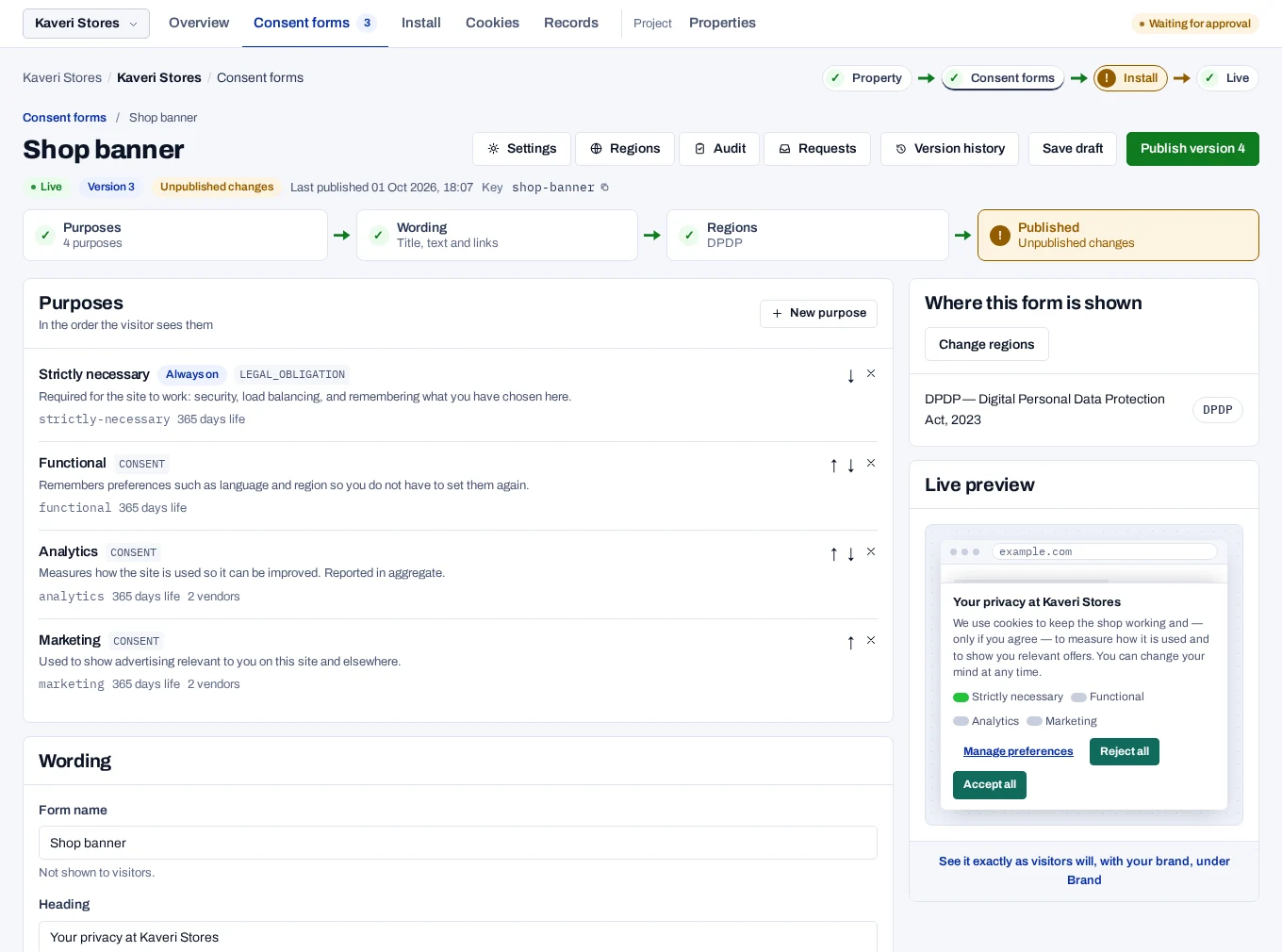
The top of the form says whether anything is waiting to be published. A banner that no region rule shows says Not shown anywhere yet; select it to choose where it shows.
The draft saves itself a moment after you stop typing. A purpose you remove stays in the registry. Add purpose > New purpose creates one in the registry and adds it to this form. Hide preview gives the form the whole width; Show preview brings the preview back.
Word it differently on this form, in a purpose's More menu, rewords it on this form only. On a form inside your own form, Required to continue holds the form until the box is ticked. Use it only for a feature that cannot work without it.
Set how the form behaves#
Choose Settings at the top of the form. Changes take effect when you publish.
| Setting | What it does | Starts |
|---|---|---|
| Privacy button | Stays on the page so visitors can reopen their choices. | On |
| Button position | Bottom left or Bottom right. | Bottom left |
| Let visitors choose partners one by one | Gives each partner its own switch. | On |
| Ask "Are you 18 or older?" | Asks the visitor's age before the purposes: Never, Where the DPDP Act applies or Everywhere. See DPDP duties for rights and children. | Never |
| Page for a parent or guardian | Your page where a parent or guardian gives consent. The banner shows it to a visitor who answers No. | Empty |
| Google Consent Mode v2 | Sends Consent Mode defaults and updates for you. | On |
For visitors in India the privacy button stays even when the switch is off. The exception is a page with its own link that opens the preferences.
An Email and marketing opt-in form has one setting instead, Require double opt-in. It starts on.
Find a form in the list
Consent forms lists every form of the property with its type, where it is shown, its version and its status. Filter by All, Live, Draft or Archived, or search by name or key. No regions chosen on a published banner form means no visitor sees it yet. The console has no control to archive or delete a form.